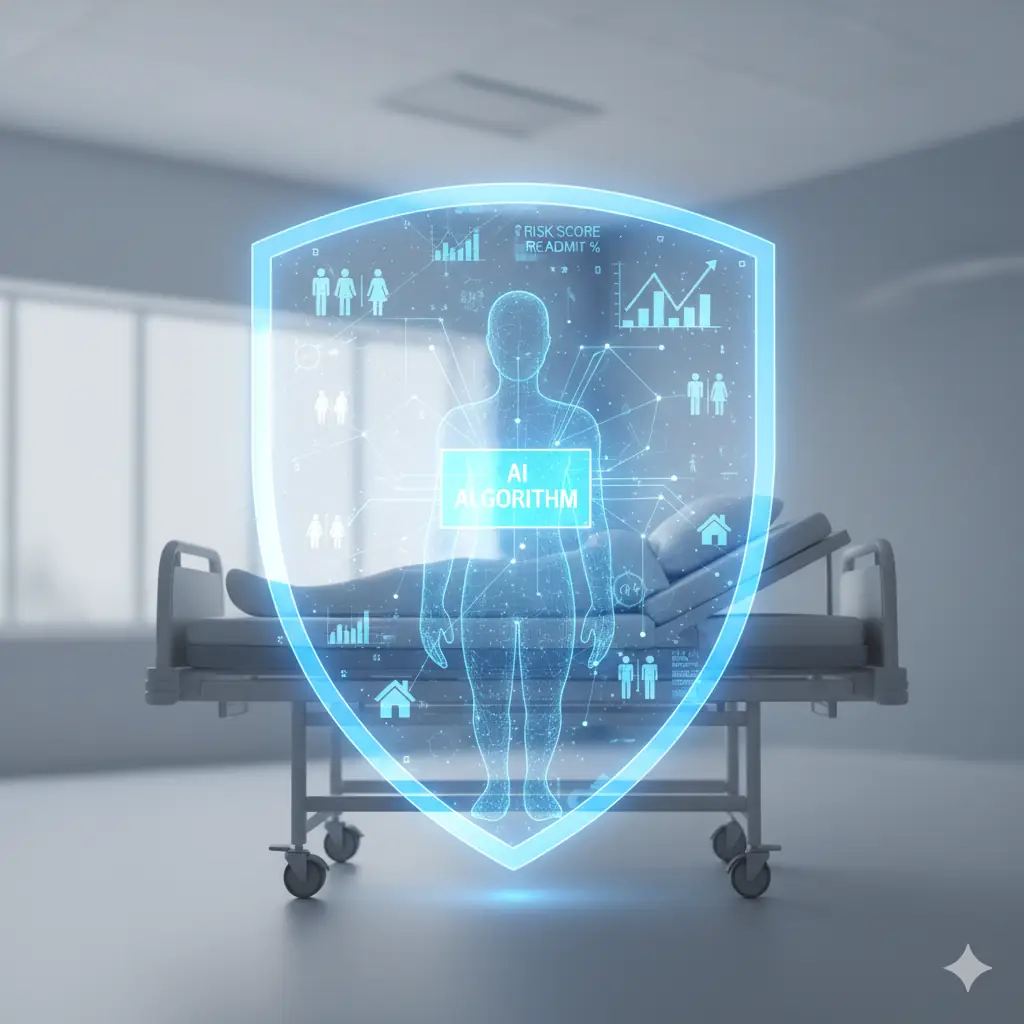


The Safety Net: How AI Predicts and Prevents Hospital Readmissions
For both patients and hospitals, a readmission shortly after discharge is stressful and costly. It often signals a breakdown in the transition of care or inadequate support once the patient leaves the facility. Globally, readmission rates for certain conditions can reach as high as 20% within 30 days, representing a major challenge in healthcare.
Addressing this issue requires more than just better paperwork; it requires foresight. This is where Artificial Intelligence shines. Here at insurancesapp.site, we’re looking at how AI uses predictive modeling to identify patients most likely to return to the hospital, enabling targeted, preventative interventions.
Why Predicting Readmissions Matters
Reducing preventable readmissions is a triple win. First and most importantly, it improves the patient experience and health outcomes by ensuring a smoother recovery at home. Second, it significantly reduces costs for the healthcare system and insurers.
Finally, many countries and health systems, including Medicare in the US, penalize hospitals financially for high readmission rates. AI helps hospitals avoid these penalties by improving the quality and safety of their discharge processes.
The Traditional Challenge of Risk Assessment
In the past, predicting readmission risk was largely based on a few basic clinical factors, such as the patient’s primary diagnosis or their number of previous hospital stays. While helpful, this approach often missed crucial, non-clinical details.
Human clinicians simply cannot sift through the thousands of data points generated during a hospital stay, synthesize a patient’s entire medical history, and simultaneously weigh non-medical factors like social support—all in the limited time before discharge.
The Power of AI: Analyzing Diverse Data
AI, specifically Machine Learning (ML), overcomes this limitation by integrating and analyzing a far broader range of data points than any manual system could handle. These factors are typically categorized into three main domains:
- Clinical Data: Includes primary diagnosis (e.g., heart failure, pneumonia), length of stay, lab results, medications prescribed, and procedures performed.
- Utilization Data: Tracks previous emergency room visits, prior hospitalizations, and frequency of specialist appointments.
- Non-Clinical (Social/Economic) Data: Perhaps the most crucial addition, this includes factors like patient age, distance from the hospital, living situation, health literacy, and access to post-discharge transportation.
By learning patterns from thousands of past patient cases, ML models can weigh these diverse factors to generate a single, highly personalized readmission risk score for every patient.
How the Predictive Models Work
Most successful readmission prediction tools use sophisticated ML models like Random Forests or Gradient Boosting Machines (GBMs). These models are essentially highly complex decision trees that evaluate thousands of patient scenarios simultaneously.
For instance, the model might find that a patient discharged with Heart Failure AND who lives alone AND has low health literacy is 10 times more likely to be readmitted than a patient with the same diagnosis who has family support and high literacy. It identifies these highly specific, synergistic risk combinations.
This allows hospitals to move away from a one-size-fits-all discharge plan to one that is highly personalized and proactive, focusing resources where they will have the greatest impact.
Targeting Interventions for High-Risk Patients
The true value of AI’s prediction is not just knowing who is at risk, but triggering an appropriate, targeted intervention before the patient leaves the facility. This turns a statistical prediction into a clinical action.
AI-Triggered Interventions:
- Enhanced Care Coordination: For a high-risk patient, the AI might automatically trigger a consultation with a social worker to assess their home environment and arrange follow-up care.
- Extended Follow-Up: The system may schedule earlier post-discharge phone calls or home health visits, sometimes within 48 hours, to check on medication compliance and address any immediate concerns.
- Medication Reconciliation: The AI can flag patients with complex medication regimens for intensive counseling with a pharmacist before they leave, ensuring they understand their new prescriptions.
By intervening specifically with the 20% of patients who carry 80% of the risk, hospitals optimize the use of their most valuable resources: their staff’s time and expertise.
Data Quality: The Foundation of Accurate Prediction
Like all AI systems, the performance of readmission models is entirely dependent on the quality of the data used for training. Incomplete, inaccurate, or biased data will lead to flawed predictions.
Hospitals must invest time in data hygiene—cleaning and standardizing the information captured in Electronic Health Records (EHRs). Furthermore, models must be trained on diverse populations to prevent algorithmic bias from causing disparities in care.
If a model is trained primarily on urban data, it might perform poorly on rural patients, leading to missed high-risk cases in those underserved communities.
The Future of Proactive Care
AI in readmission prediction is constantly evolving. Future models will likely integrate real-time data from wearable sensors (tracking activity, sleep, and heart rate) into the risk calculation.
Furthermore, explainable AI (XAI) is becoming crucial. Clinicians need to know not just *that* a patient is high-risk, but *why*. Understanding the model’s reasoning—”This patient is high-risk due to low social support and a high BMI”—allows the care team to design a practical, specific discharge plan rather than relying on a blind score.
Statistics Insight: A 30-day readmission is often defined as an unplanned admission to any acute care hospital within 30 days of discharge from a previous acute care hospitalization. Reducing this metric is a key focus for global health systems seeking efficiency.
Ultimately, AI serves as a powerful safety net, allowing hospitals to proactively manage risk at a scale that was previously unimaginable. This shift from reactive treatment to predictive care is fundamental to delivering higher quality, lower-cost healthcare in the modern age.
By embracing these predictive tools, hospitals can help more patients recover successfully at home, where they truly want to be. Stay tuned to insurancesapp.site for more on this innovative blend of AI and medical efficiency.