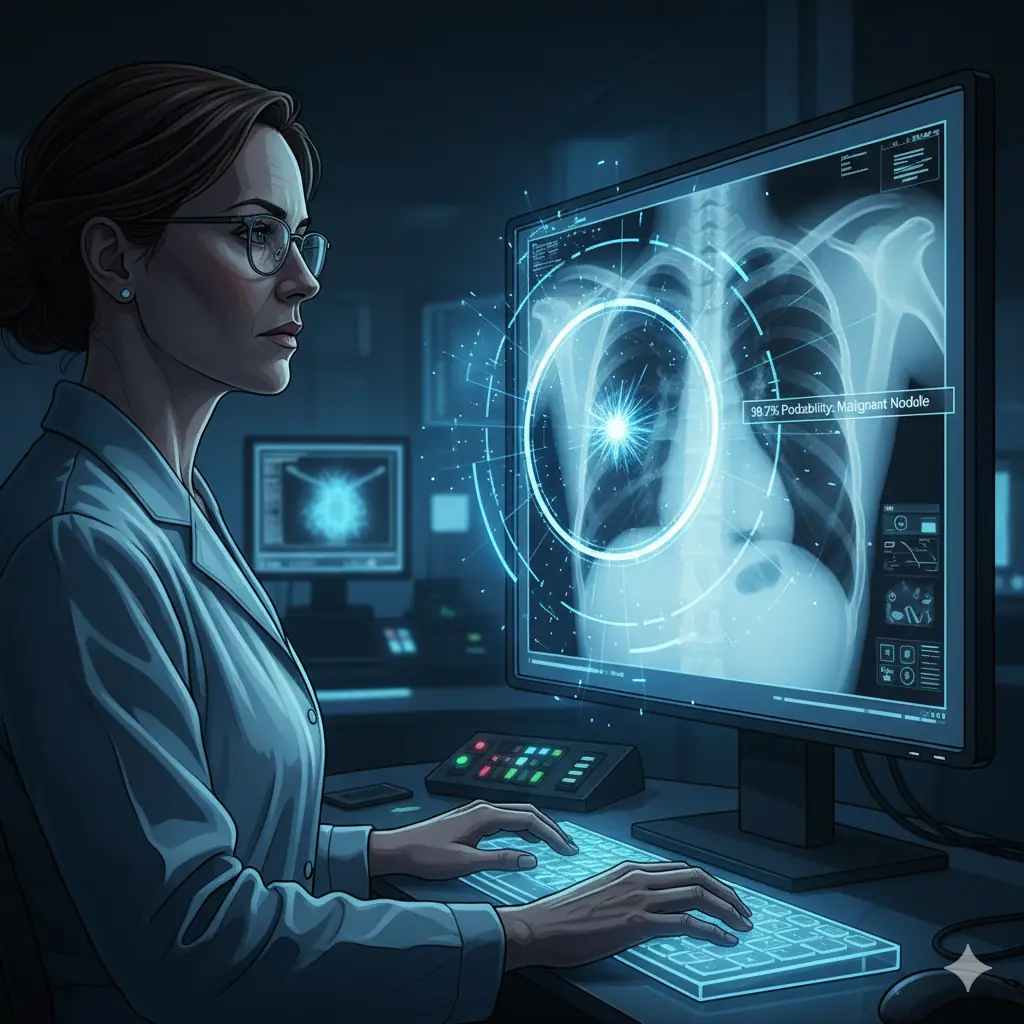


The AI Radiologist: How Deep Learning Revolutionizes Medical Image Analysis
Welcome back to insurancesapp.site, where we explore the fascinating intersections of technology and health. Today, we’re diving deep into one of the most impactful applications of Artificial Intelligence: using deep learning to interpret and detect diseases from medical images.
It’s no exaggeration to say that AI is fundamentally changing the field of diagnostics. Instead of replacing human expertise, these sophisticated algorithms act as powerful, tireless co-pilots, helping clinicians spot subtle patterns that might otherwise be missed in vast datasets.
The Foundation: Convolutional Neural Networks (CNNs)
At the heart of AI-driven image analysis lies the Convolutional Neural Network (CNN). If you’ve ever wondered how a computer ‘sees,’ the CNN is the primary mechanism. It’s a specialized type of neural network designed to process pixel data with high efficiency.
A CNN doesn’t look at an image all at once. Instead, it breaks the image down into smaller, manageable chunks. It applies ‘filters’ or ‘kernels’—essentially small matrices of numbers—to these chunks to detect specific features, like edges, corners, or textures.
Think of it like an apprentice artist learning to draw. Initially, the apprentice only sees basic lines. As they train, they learn to combine those lines into shapes, and eventually, those shapes into complex objects—like a tumor boundary or a retinal bleed.
The Training Process: From Pixels to Pathology
The success of these systems hinges entirely on the quality and volume of their training data. An AI model is fed millions of medical images—X-rays, MRIs, CT scans, and pathology slides—each meticulously labeled by expert radiologists.
For example, to train an AI to detect lung nodules, the model is shown thousands of CT slices. Each image is marked with a bounding box indicating the precise location and nature of any nodules. This process is called supervised learning.
Through repetitive training, the CNN learns to correlate specific visual features—say, a small, dense, irregular cluster of pixels—with the label ‘malignant nodule.’ It’s constantly adjusting the internal weights of its filters to minimize the difference between its prediction and the expert’s label.
Key Techniques in Image Detection
AI’s ability to interpret images goes beyond simple classification (Is the image healthy or diseased?). Modern systems use several advanced techniques to provide actionable clinical insights:
- Image Segmentation: This is where the AI precisely outlines the boundaries of a lesion or organ. For example, it might segment a tumor on an MRI to calculate its exact volume, aiding in treatment planning.
- Object Detection: A more complex task than simple classification, this involves drawing a box (a bounding box) around every instance of a disease marker in the image and labeling it. This is crucial for detecting multiple, small polyps in a colonoscopy video, for instance.
- Feature Extraction and Heatmaps: The AI can generate a ‘heatmap’—often called a saliency map—that visually highlights the specific pixels that contributed most to its final diagnostic decision. This increases transparency and allows the human clinician to verify the AI’s reasoning.
The ability to visually explain its reasoning is particularly important in medicine, addressing the ‘black box’ problem and building trust among healthcare professionals.
Practical Applications in the Clinical Setting
The impact of AI on diagnostic imaging is already widespread, offering tangible benefits in speed and accuracy across various medical disciplines:
| Disease or Condition | Imaging Modality | AI’s Role |
|---|---|---|
| Diabetic Retinopathy | Retinal Fundus Photography | Automatic detection and grading of hemorrhages and microaneurysms, often faster than human screening. |
| Breast Cancer | Mammography | Second-read assistance, identifying subtle calcifications or masses, leading to earlier detection and reduced false negatives. |
| Stroke | CT/MRI Scans | Rapidly segmenting areas of ischemia or hemorrhage to triage critical cases within minutes, reducing time-to-treatment. |
| Tuberculosis | Chest X-rays | Low-cost, scalable screening in resource-limited settings by identifying patterns indicative of active TB. |
In a high-volume setting like an emergency room, AI can be a game-changer. Imagine an AI prioritizing a scan showing a small, acute intracranial bleed over a routine fracture, ensuring the patient gets immediate attention.
The Collaborative Future: Human-AI Synergy
It’s vital to frame this technology not as a competitor, but as an indispensable partner. Human radiologists bring contextual knowledge, ethical judgment, and the ability to synthesize findings from multiple sources (patient history, labs, and other scans) that an AI simply cannot replicate.
However, AI can perform the tedious, repetitive task of scanning images for the first signs of abnormality with superhuman consistency. This frees up the human specialist to focus on the most complex cases, improving overall workflow efficiency and reducing burnout.
A Note on Ethical Responsibility: While AI is incredibly powerful, it is only a tool. The final diagnosis and treatment decision always remain the responsibility of the qualified medical professional. This ensures a human touch and accountability in every patient care pathway.
Challenges and Considerations
While the technology is transformative, it isn’t without its hurdles. Achieving truly effective deployment requires careful consideration of its limitations:
- Data Bias: If the training data disproportionately represents one demographic, the model may perform poorly on others, leading to disparities in care. This requires careful auditing of training datasets.
- Generalization: An AI trained successfully on images from one hospital’s machine might struggle when encountering images from a different model or brand (e.g., a Siemens CT vs. a GE CT).
- Regulatory Approval: Integrating these tools into clinical practice requires stringent testing and approval from regulatory bodies, which can be a slow, complex process to ensure patient safety.
| 🤖 Key Advantages (Pros) | ❌ Current Limitations (Cons) |
|---|---|
| Speed and Efficiency: Can analyze thousands of images far faster than a human, reducing turnaround time. | Lack of Context: Cannot incorporate patient’s social history or nuanced clinical presentation. |
| Consistency: Doesn’t suffer from fatigue or distraction, providing consistent error rates. | Data Dependency: Performance is limited by the quality and diversity of the initial training data. |
| Early Detection: Identifies subtle patterns too faint or complex for the human eye, improving prognosis. | Over-Reliance Risk: Potential for human clinicians to trust the algorithm blindly without critical review. |
As we move forward, the field will focus on developing models that are not only accurate but also robust, transparent, and fair across diverse populations. The AI radiologist is here to stay, and its collaboration with human expertise promises a healthier, more accurate future for diagnostics.
Stay tuned to insurancesapp.site for more on how AI continues to reshape the landscape of medical research and patient outcomes.